
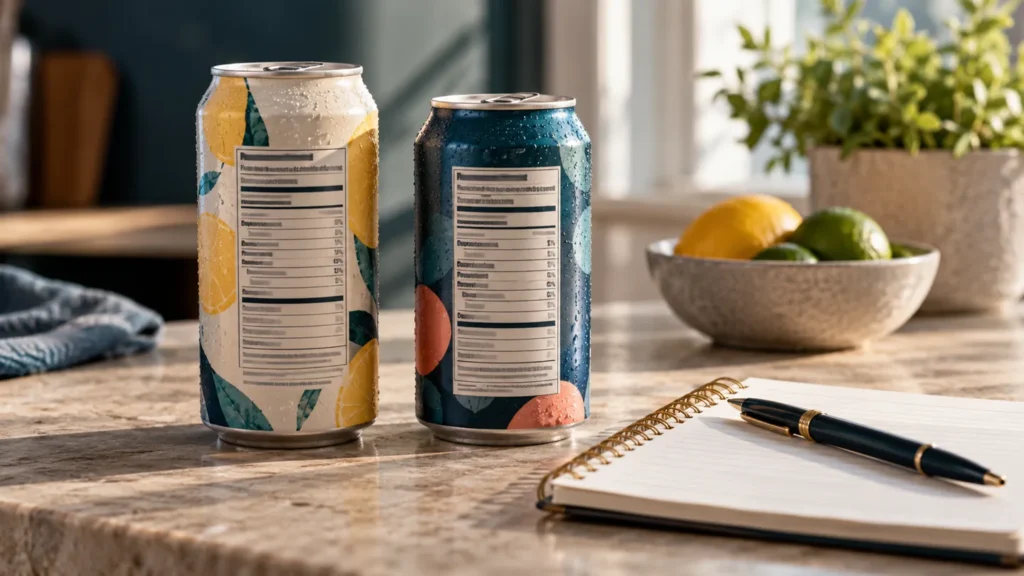
To compare calories between beverage cans, first decide what you are comparing: one labeled serving, one full container, or an equal volume. Mixing these approaches can make a larger package look like a different product choice than it really is.
Start with the Nutrition Facts panel
The FDA’s serving-size guidance explains that nutrition information is generally based on a serving and that packages can contain more than one serving. Check for any additional per-container column before doing your own calculation.
In a hypothetical example, 20 calories per serving in a two-serving container would total 40 calories for that container. A separate one-serving can labeled 30 calories has a different container total. This arithmetic compares the labels; it does not determine which drink you should choose.
Keep a consistent note
- Container volume.
- Labeled serving size and serving count.
- Calories per serving.
- Calories per container, if stated or calculated from the label.
If you compare equal volumes, clearly label that calculation so it is not mistaken for the manufacturer’s serving information. Avoid inferring calories from words such as seltzer, lemonade, or soda alone.
Source: FDA serving-size guidance. Browse beverages and more label guides.